
McKinney Previous Residents Source Eras
A backward McKinney address trail needs more than one record type. The current parcel record supplies an identifier. A recorded instrument can connect parties and a legal description. A directory can place a printed name at an address in a publication year. Census, map, tax, and newspaper material can then test the sequence. Keep the source date beside every result. That avoids turning a single current record or historic entry into a claim about continuous presence.
| McKinney source | Years it covers | Where held | What it can show |
|---|---|---|---|
| CCAD parcel record | Current tax-account context | Collin Central Appraisal District | Property and geographic IDs, legal description, deed references, and current tax fields |
| County Clerk Historical Records | 1843-1975 | Collin County Clerk | Early recorded-instrument research route |
| Collin County deeds catalog | Indexes 1846-1970; deed volumes beginning 1846 | FamilySearch catalog | Index and volume leads for earlier title work |
| McKinney directories | Selected years from 1933 through later decades | UNT and library collections | Dated printed names, streets, telephones, and household clues |
| Federal census schedules | 1850-1880 and 1900-1940 | Library microfilm holdings | Household context; 1890 was destroyed |
| Sanborn map | 1888, four sheets | Library of Congress | Structure and block context, not a people list |
Start with the newest documented parcel and work backward. If the question is about a structure rather than a person, use the legal description and map layer first. If the question is about a historic household, use a directory year and then look for a compatible census or newspaper date. A blank period is a finding, too. Mark the next source to inspect rather than inventing a link.
McKinney Parcel Keys First
Begin with CCAD, using the current address or owner search to locate the property ID and geographic ID. The Advanced search supports fields such as owner name, street number and name, property ID, subdivision, tax year, neighborhood, and legal description. Search hints recommend simplifying a street to its name and omitting a suffix, prefix, or unit when a full address produces no result. Preserve the original address in notes even when the search is simplified.
A CCAD record can include an owner field, mailing and situs addresses, legal description, parcel and geographic identifiers, land and improvement values, exemptions, inspection information, notes, and deed references. These fields have different meanings. A situs address identifies the taxable location; a mailing address is a tax-bill destination; an owner entry is not proof of who was physically present. Save the result date, property ID, geographic ID, legal description, and any deed reference before moving to a title record.
The city’s Addresses and Boundaries MapServer can help compare an address point with parcel geometry, ZIP, city limits, or ETJ. Those layers establish place context. They do not identify a household. Carry the parcel identifier from the map or CCAD into the County Clerk search instead of relying only on a familiar street string.
McKinney Legal Description Insight
For McKinney previous residents research, the legal description usually survives address change better than the street address. The city’s Research Your House guide directs researchers to get the legal description from CCAD and use it for the title chain. A subdivision, lot, block, tract, or metes-and-bounds description can follow the land through a renumbered street, a new postal label, or a parcel split.
Keep a parallel address chain: address as printed, normalized address, property or geographic ID, legal description, recorded instrument, source date, and confidence. A current property ID is a practical key, but it can change when land is split or recombined. The legal description and recorded document give a stronger historical bridge. When they disagree, record the disagreement and check the tax year, recorded instrument, and any later correction rather than choosing a version silently.
Record boundary. A familiar street address is not always the best historical search key. McKinney’s house-research instructions favor the legal description because the lot can remain identifiable even when the street form, number, or parcel account changes.
McKinney Deed Chain Steps
The County Clerk search turns a current parcel into a backward title sequence. Search party names in both directions because a married person, estate, trustee, or corporation can appear under an unexpected index field. A recorded date and an instrument date should both be preserved. The instrument can be signed before it is filed. Check the document type before deciding what the entry represents, because a release, plat, lien, or correction does not necessarily transfer ownership.
- From CCAD, record the current property ID, geographic ID, legal description, and every displayed deed reference.
- Use the Collin County Clerk land-recordings route to find the newest instrument connected to the legal description or recorded party.
- Read the grantee on that instrument, then search the prior holder as a grantee to locate the earlier acquisition.
- Repeat backward, keeping grantor, grantee, document number, recorded date, instrument date, type, book or page, and legal description in date order.
- For early McKinney, use the Clerk’s 1843-1975 Historical Records route and the library or catalog leads, then verify the actual image and its availability with the Clerk.
- Grantor
- The party transferring or granting an interest in a recorded instrument.
- Grantee
- The party receiving that interest. A prior seller can often be found as a grantee on the earlier purchase.
- Chain of title
- A dated sequence of recorded instruments connected through the same land description.
- Instrument date
- The date on the document itself, which can differ from the date the clerk recorded it.
McKinney Clerk Search Fields
The County Clerk’s advanced record search supports more than a name. Use grantor or grantee, instrument date, recorded date, document type, document number, book and page, lot and block, subdivision, and legal description as separate routes. With a common surname, narrow the time span or add the subdivision and instrument type. Search recorded dates separately from instrument dates so a filing delay does not look like a missing transaction.
| Grantor and grantee | Party-name fields that help move backward and forward through linked instruments. |
|---|---|
| Instrument and recorded dates | Two dates that should be retained separately in a chronology. |
| Document number; book and page | Stable retrieval details when a broad party search returns too much. |
| Lot, block, subdivision, legal description | Land identifiers that can outlast a street-number or parcel-account change. |
| Document type | Distinguishes deeds from liens, releases, plats, assignments, and corrections. |
After opening a plausible result, compare parties, legal description, execution or acknowledgment, recording stamp, type, and redactions with the CCAD parcel card. The research value comes from the comparison. A word match in OCR is less reliable than a matching legal description and recorded reference. Keep a missing book or page as an unresolved point, not a repaired fact.
McKinney Index Versus Instrument
The online search index is a useful discovery layer, but the County Clerk warns that it is not the official repository. A result can provide a party, type, date, document number, or legal-description lead. It can also display an unofficial watermarked image. For an authoritative copy need, follow the Clerk’s current purchase and registration process for an unwatermarked PDF or ask the office to verify the record. Record which layer was actually inspected.
The Collin County land-recordings guidance describes the official-records route and search context.
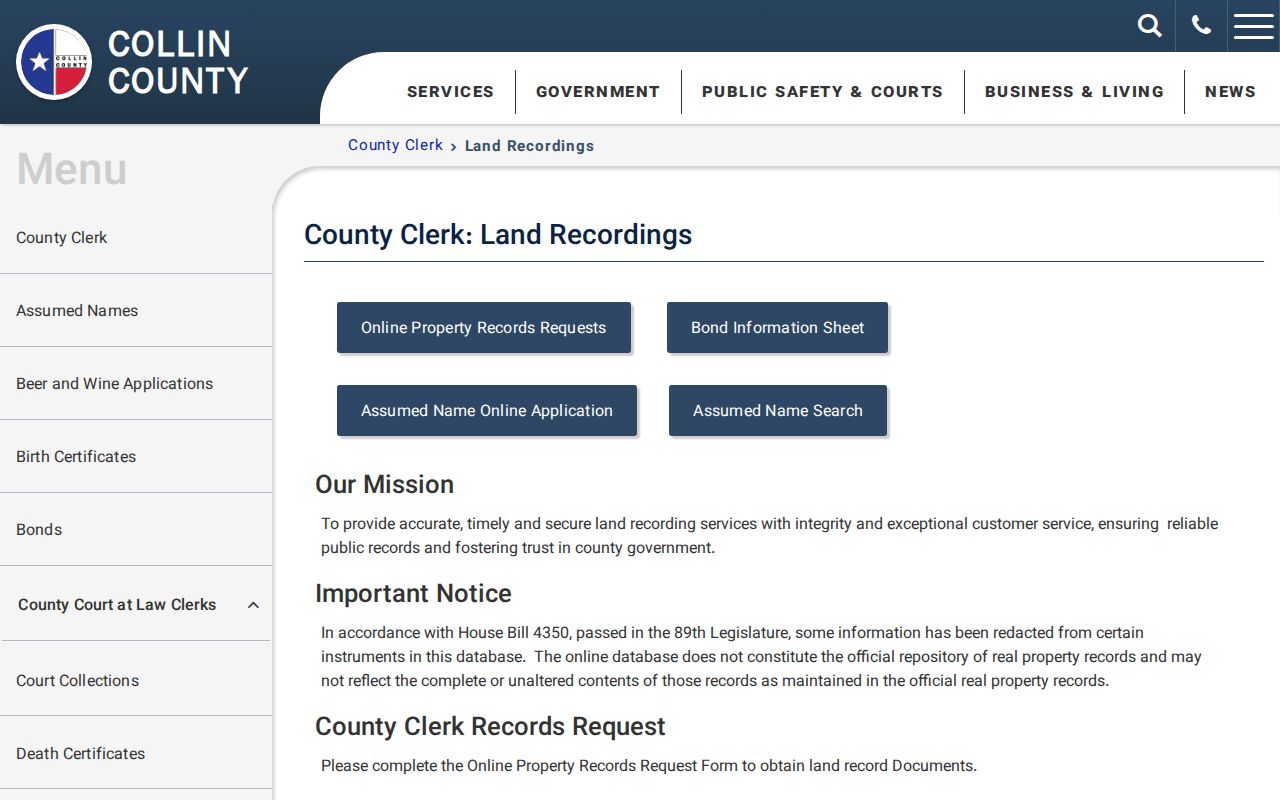
An index can identify a promising document while the instrument contains the fuller legal description, acknowledgment, consideration, exceptions, and redactions. Write “index result and unofficial image inspected,” “unwatermarked copy obtained,” or “Clerk verification needed.” That wording tells another researcher what evidence exists without overstating the status of a download.
McKinney Previous Residents in Directories
Deeds trace interests in land. Directories and census schedules add dated household context. McKinney’s 1933 street page lists a street, number, names, and intersections. The 1938 name entry can show a spouse notation, occupation, address, telephone, and children. The library holdings list Collin County federal population schedules for 1850, 1860, 1870, 1880, 1900, 1910, 1920, 1930, and 1940. The 1890 schedule cannot fill a gap because it was destroyed.
- Find a historic address or name in a cited directory year.
- Search the nearest listed census year for the compatible place, name, and household context.
- Test the result against a deed, tax roll, newspaper notice, or map instead of treating either source as complete.
- Record whether the directory entry, census image, or only an index was inspected.
The McKinney city directory collections preserve the publication details, street sections, and name-entry patterns behind this step. A person in a printed directory is a dated historical mention. A deed party is a party to a recorded instrument. Those descriptions should not be merged into one stronger claim without matching identifiers and compatible dates.
McKinney Maps for House History
For a McKinney house, the city’s house-research workflow calls for the title chain, buyers and sellers, dates, amounts, instrument types, Notices of Completion, major mortgage or tax-value changes, directories, newspapers, census, Sanborn maps, photographs, and oral interviews. A Notice of Completion may name a builder or architect. A first large mortgage or tax-value change can be a construction clue, not proof by itself. CCAD’s Residential Building Record may hold configuration changes and assessor notes, but the estimated year built can be wrong.
The 1888 McKinney Sanborn map covers four sheets. It can show footprints, construction material, stories, house and block numbers, outbuildings, boundaries, water facilities, and fire-protection context. It cannot identify every person at an address. Pair a map date with an address directory, deed, or newspaper. The city’s microfilm holdings also list a McKinney Sanborn reel.
McKinney Previous Resident Gaps
A long break in an address trail should be visible in the notes. Next searches might include a County Clerk deed index, the 1846-1910 tax rolls, a directory year, a cited newspaper page, a cemetery record, or a clerk request. The FamilySearch Collin County deeds catalog identifies indexes from 1846-1970 and deed volumes beginning in 1846, but it is a catalog lead. The County Clerk or source repository should verify the actual image, volume, and current access.
Use confidence labels to make the reasoning legible. “Exact” can mean the legal description and street context agree. “Probable” can mean the directory, deed, and map align while one key is absent. “Possible” may rest only on a name and address overlap. “Unresolved” means the sources conflict or the time gap remains too wide. A confidence label is a research aid, not an official status.
McKinney Property Alert Limits
Collin County Property Alert is a free, third-party-hosted notification service that can send email when a name or other keyword appears in a real-property filing. The county describes tax liens, releases, and possible fraud as examples of why an owner may monitor their own name. It is supplied AS-IS and disclaims completeness and liability. It is a personal monitoring aid, not a complete historical record and not a tool for following other people.
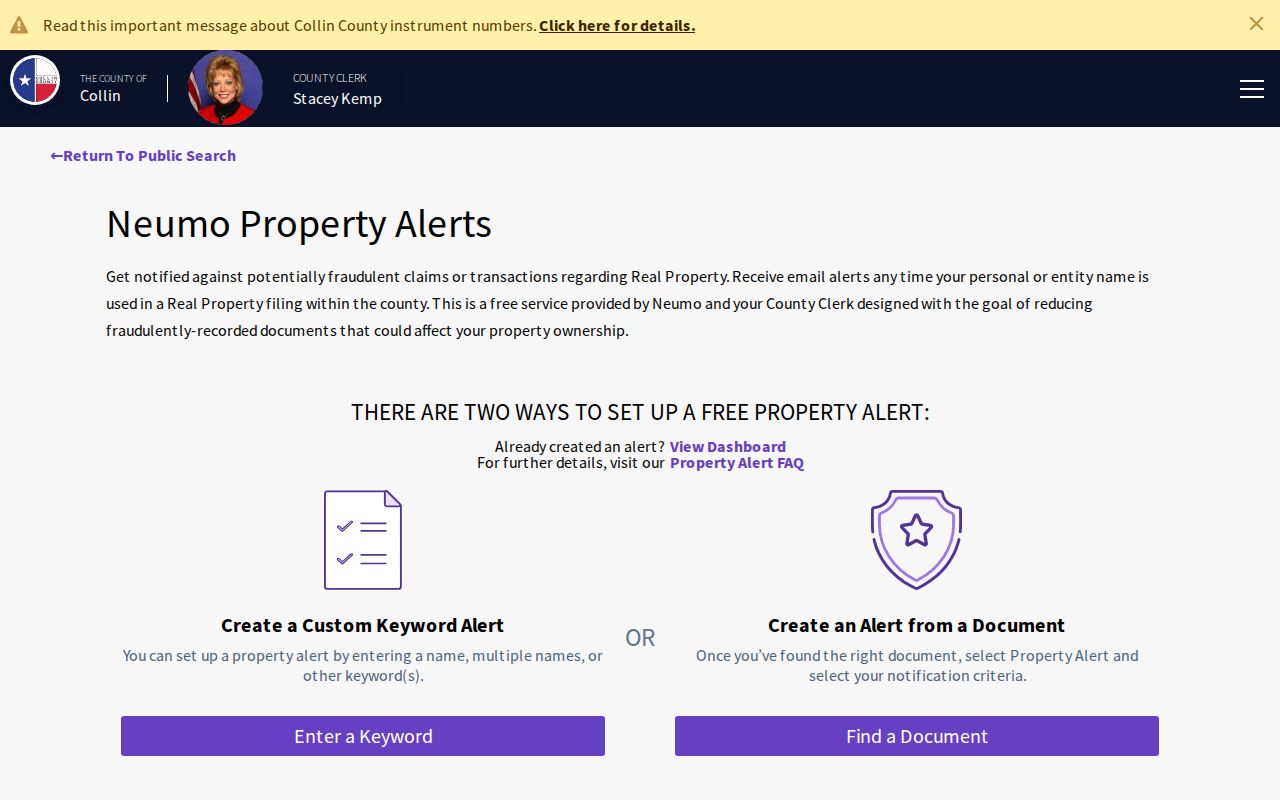
Use an alert as a prompt to inspect the recorded instrument through the proper County Clerk route. Save the document number, dates, parties, type, legal description, and result status. An alert can flag a filing, but it does not replace the original document, the parcel record, or a cited historic source.
McKinney Personal History Boundaries
McKinney previous residents research is best used for house history, family history, heirs, preservation work, and personal curiosity. Keep a limited record of the source, date, document identifier, and evidence type. Leave out sensitive fields that do not serve those purposes. A current parcel card, older directory, map, or index may contain different kinds of information, and none should be used to pursue, stalk, harass, or harm a living person.
Lawful use. Treat an address history as a record trail, not a profile of living people. Confirm material facts with the office that holds the record, and preserve the difference between an official instrument, a historical publication, an index result, and an unresolved lead.