
McKinney Resident Lookup Coverage
Different McKinney records answer different questions. The Collin County Appraisal District property search ties a tax account to an owner, mailing field, situs field, parcel identifier, and legal description. Collin County's judicial search identifies a court matter. Texas voter tools describe a registration record, while vital and obituary sources can place an event or notice in time. Treat each result as evidence of its own record type rather than as a complete profile of a McKinney resident.
| Record | What it can establish | McKinney source | Access route |
|---|---|---|---|
| Property account | Tax-account owner, mailing and situs fields, parcel identifiers | Collin County Appraisal District | Open property search, marked research only |
| Court index | Case number, party role, style, type, date, status, and court | Collin County Case Search | Online within its stated coverage, clerk route for older records |
| Voter record | Registration status and official voter information | Texas My Voter Portal or Collin County Elections | Portal or county list request, with statutory limits |
| Vital record | Whether an event is on file, or a qualified certified copy | Texas DSHS and the County Clerk | Order, verification, or local request as allowed |
| Obituary index | Dated newspaper citation and name fields | McKinney library index | Online index, then the cited source |
Use the property account first only when the question concerns a parcel or tax mailing field. Use a court search first when a case number, citation, or court event is the known fact. For a historical McKinney name, an obituary or directory result can supply a date and spelling before any county search. A result should retain its source date, the exact name searched, and a label such as property record, case index, verification, or historical mention.
Match McKinney Residents With Two IDs
A name alone is a weak match in McKinney, especially when a surname appears in several local systems. Compare at least two independent identifiers before connecting records. Useful pairs include a full name and a case number, a parcel identifier and legal description, or an obituary date and cited newspaper page. A year range can also separate a historical directory mention from a modern tax account. Keep the name exactly as each source prints it, including middle initials, spouse notation, estate wording, or punctuation.
The CCAD search accepts owner name, street number and name, property ID, geographic ID, owner ID, property type, subdivision or neighborhood fields, tax year, and legal-description components. Its owner and mailing fields are valuable tax-account facts, but neither proves that the named person occupies the situs address. A legal description and parcel or geographic identifier are steadier links when a street name, number, or postal ZIP has changed.
Record boundary. An owner field, a mailing address, or a case status does not prove identity or current occupancy. Each describes a separate official record and must be labeled that way.
Check a McKinney Resident Court Match
The single Case Search accepts a name, case number, or citation and searches case types through one route. Its documented coverage is Justice of the Peace, civil, and probate matters from 1984 forward, district criminal matters from 1988 forward, and county criminal matters from 2000 forward. Older records follow a different path through the appropriate clerk, with manual, written, or in-person searching. The county also points to Tyler Public Access for one case type at a time and real-time active or historical access where available.
A court result needs careful reading. Preserve the party role, exact case style, case type, court, filing or result date, and displayed status. A civil filing is not a finding. A probate style may name an estate rather than a living party. Terms such as open, dismissed, disposed, deferred, judgment, and warrant have different procedural meanings. When the name is common, compare the style and history with another lawful record rather than treating a search hit as a conclusion.
The official civil lookup guide shows why this inventory matters. Its example displays a case number, full style, date, type, status, judge, and a Case History path. It says document access requires a physical visit to the District Clerk at 2100 Bloomdale Road. That is a model for recording fields, not a story about a current McKinney person.
- Case number: the identifier for the court file.
- Style and party role: the exact caption and role shown by the court.
- Type and status: the court's categories, retained without interpretation.
- Judge and history path: context for checking the docket or clerk record.
Note: A no-result may reflect the court's coverage date, a name variation, or an older record that the clerk must search manually.
Verify McKinney Voter Records
The Texas voter portal has documented lookup paths using driver license and date of birth, name plus county and date of birth, or VUID and date of birth. The official route can provide registration and voting-location or status information. Collin County Elections is the source for county list requests. Its documented public list fields include county and state ID, registered and mailing addresses, districts, registration dates, active or suspense status, and history. Phone numbers and email addresses are not included.
Suspense is not cancellation. It signals a status that requires confirmation rather than an automatic conclusion about a McKinney resident. Texas Election Code rules protect sensitive identifiers, and the state documents address suppression for qualifying voters. The county says voter lists cannot be used for commercial advertising or promotion. Preserve the source date, status label, and field limits instead of copying a full record into a research note.
The official My Voter Portal is shown here as a documented state lookup route.
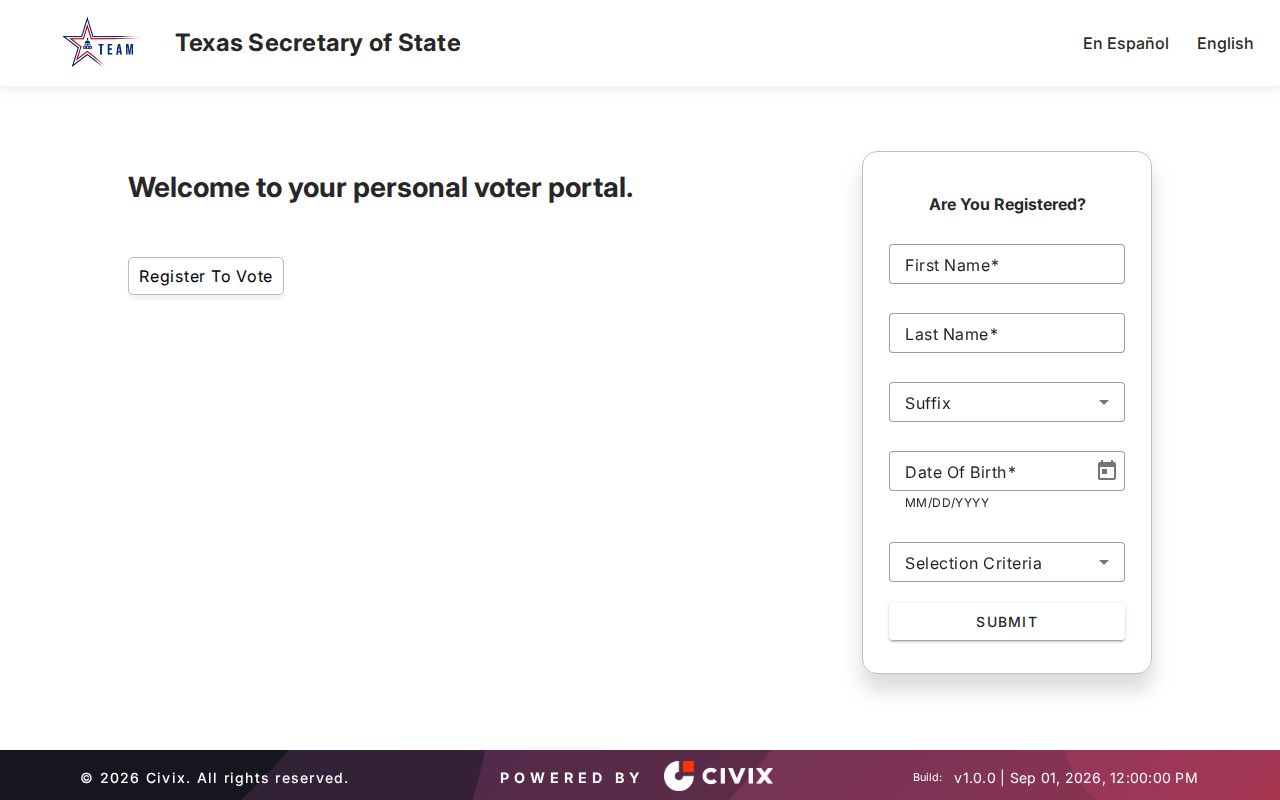
Use the portal result as a voter-registration record, then keep it separate from a tax-account owner or historical newspaper mention.
Confirm McKinney Resident Vital Records
Texas vital records can verify an event without giving every requester the underlying instrument. Texas.gov vital records describes online, mail, and in-person routes for eligible orders. DSHS limits protected certified copies to the subject, immediate family, a guardian or legal representative, or a person who establishes direct tangible interest. Government Code §552.115 makes birth records public on the 75th anniversary and death records public on the 25th anniversary, subject to stated exceptions. A marriage or divorce verification is not the license or decree.
The DSHS forms page identifies VS-140 for birth, VS-142 for death, and VS-142.9 for marriage or divorce verification. A verification can say that an event is on file and may identify names, date, and county. It does not replace a certified record. For a local copy or form, the Collin County Clerk forms page is the county route. Record whether the evidence is an index entry, verification, or certified copy.
The DSHS qualified-requester rules explain the access boundary before an order begins.
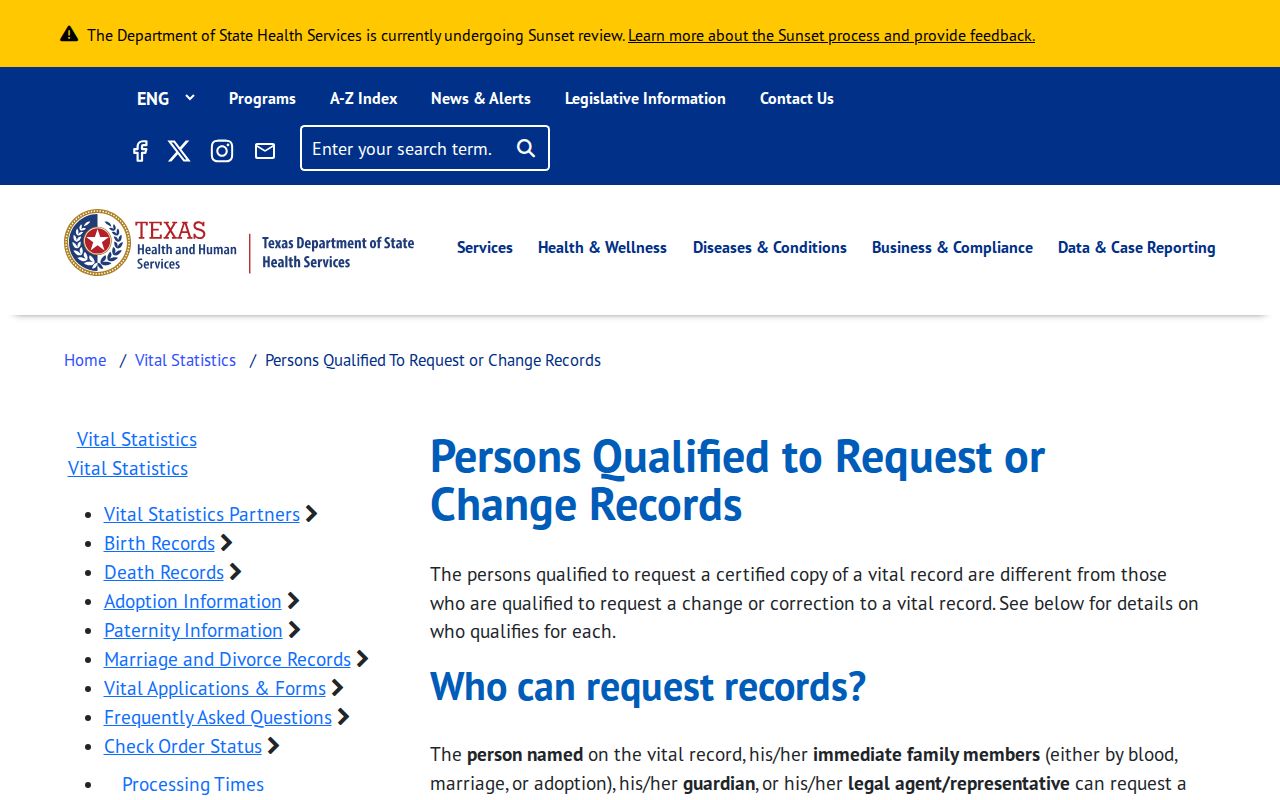
The screen is a reminder to select the right form and access route, not a substitute for the record held by DSHS or the County Clerk.
Use McKinney Resident Obituary Leads
For historical McKinney resident research, the library's obituary index is a lead to a newspaper issue rather than proof by itself. Its 1884 to 1899 endpoint displays last name, first name, title, maiden name, paper, date, page, and second date or page citations when present. Those fields support a reproducible next step: locate the cited page, preserve its date, and compare it with a directory, probate matter, or deed only where the identifiers agree.
McKinney library resources also point to obituary indexes for later periods, microfilm, oral histories, maps, and local directories. Historical names can appear under a spouse's name, a shortened name, or a changed street number. A missing entry means the person was not found in that index under those search terms. It does not establish that no event occurred.
The McKinney obituary index shows the cited fields that should accompany any historical lookup note.
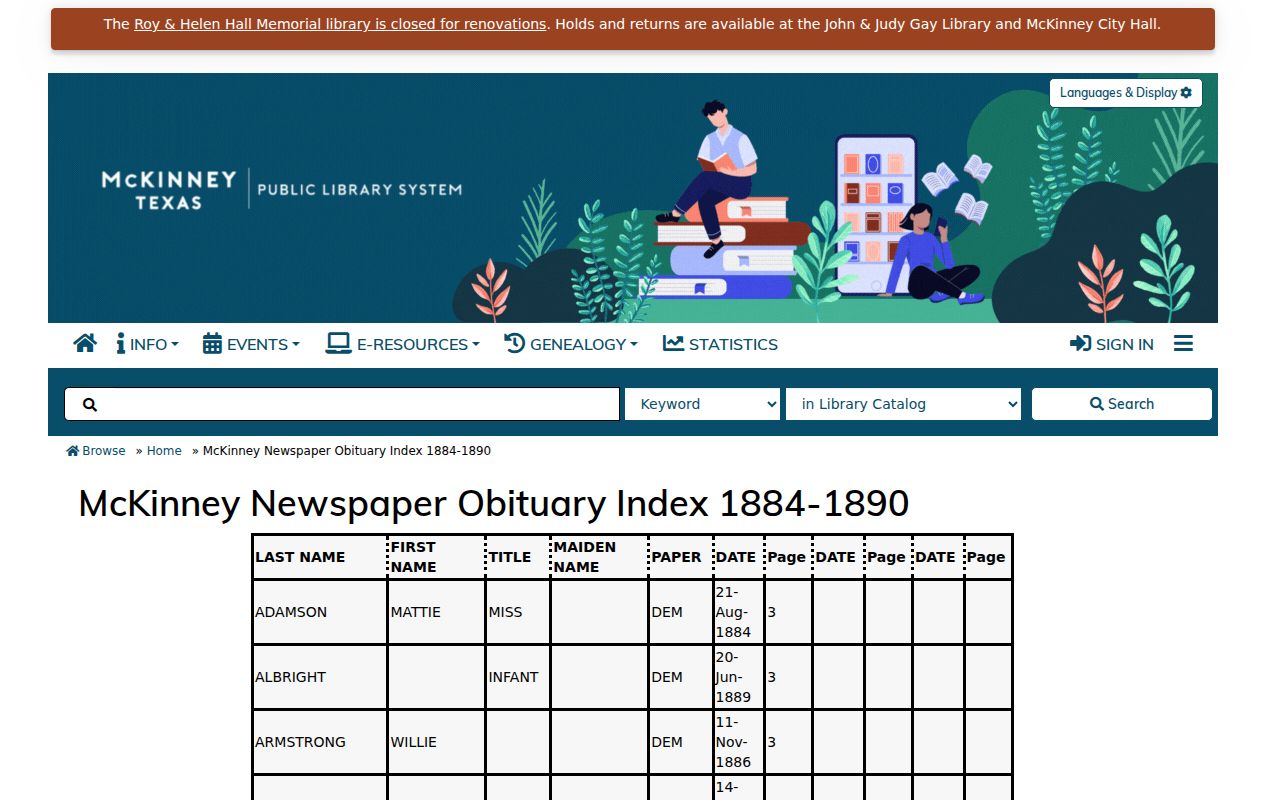
Pair the index result with its newspaper page or another dated original source before making a family-history connection.
Separate McKinney Residents From Filings
A business, permit, assumed-name, or license record may include an address, but it identifies the subject of that filing, not automatically a McKinney resident. Texas SOSDirect offers searches for filings, certificates, assumed names, and UCC records. The Secretary of State describes a $1 authorized search charge and redaction of certain personal data. A registered office is not automatically a home address, and a filing's listed contact is not automatically the entity owner.
Collin County's assumed-name process is another separate trail. The County Clerk says searches are free online or in person and $10 by mail. An online application for an unincorporated assumed-name certificate is followed by a McKinney or Plano visit within 10 calendar days, with partner appearance rules where applicable. Label the result as a DBA, entity filing, license, permit, or property record. That distinction prevents an address from being assigned a meaning the record does not support.
Verify a McKinney Resident Across Records
Use a short comparison process instead of accumulating every result tied to a name. Begin with a result that answers the exact question, then seek an independent record with a different purpose. For example, a historical obituary citation and probate case style may both support a family-history lead if the name, time period, and other identifiers match. A current property account and a court case need even more care because they prove different things.
- Write the full name as known, reasonable spelling variants, the date range, and the question being tested.
- Search the official source most closely tied to that question, then save the source date and each displayed identifier.
- Compare a second independent source, retaining its record type rather than relabeling it as residence evidence.
- For a needed document or older case, contact the named custodian and ask for the narrow record, date range, and copy route.
- Docket
- A court's running record of events in a case. It is not the same thing as a final outcome.
- Index and image
- An index points to a record. An image is the displayed document or page and may be restricted, watermarked, or available only through a clerk.
- Certified copy
- A copy issued by the custodian with the certification required for official use. It is different from an online search result or verification letter.
A dated directory mention can extend the trail backward. The historical volumes and how to read them are addressed in the McKinney city directories collection.
McKinney Lookup Matching Tip
For a common surname, start a simple result inventory before deciding that any records belong together. Capture the source name, search terms, date searched, record type, date range, identifiers, and what the result actually establishes. Compare two independent identifiers, such as exact case style plus a dated obituary citation, or parcel ID plus legal description. This slower method often exposes a spelling variant, an estate record, or a time gap that a name-only search hides.
When an official portal is unavailable or a date falls outside its coverage, use the custodian's alternate route. Collin County directs older court records to the relevant clerk for manual, written, or in-person searching. Texas public-information requests should go to the agency that created or holds the existing record, with a narrow date range and record description. An agency may redact protected details or explain that no responsive record exists.
Legal Limits for McKinney Resident Lookup
Texas public-record access has important limits. Government Code Chapter 552 protects recent birth and death records, certain addresses and contact details, motor-vehicle information, Social Security numbers, and other categories. Texas Election Code provisions also protect driver-license and other sensitive voter identifiers. The Secretary of State address-confidentiality information explains that website suppression does not erase an underlying record or override every lawful access path.
The Address Confidentiality Program gives qualifying participants a substitute address and special voter-record handling. The Texas Comptroller also provides a Tax Code §25.025 restriction form for qualified property owners. Do not copy protected details from a displayed record, and do not try to work around a custodian's redaction. Use the minimum information needed, preserve the custodian link and search date, and ask the office that holds a record about a correction.
Lawful use. Use McKinney records for personal, lawful research and source verification. Never use a result to stalk, harass, intimidate, impersonate, or harm another person.
Note: A protected field or an unavailable result is a limit to respect, not an invitation to find the information through another route.